
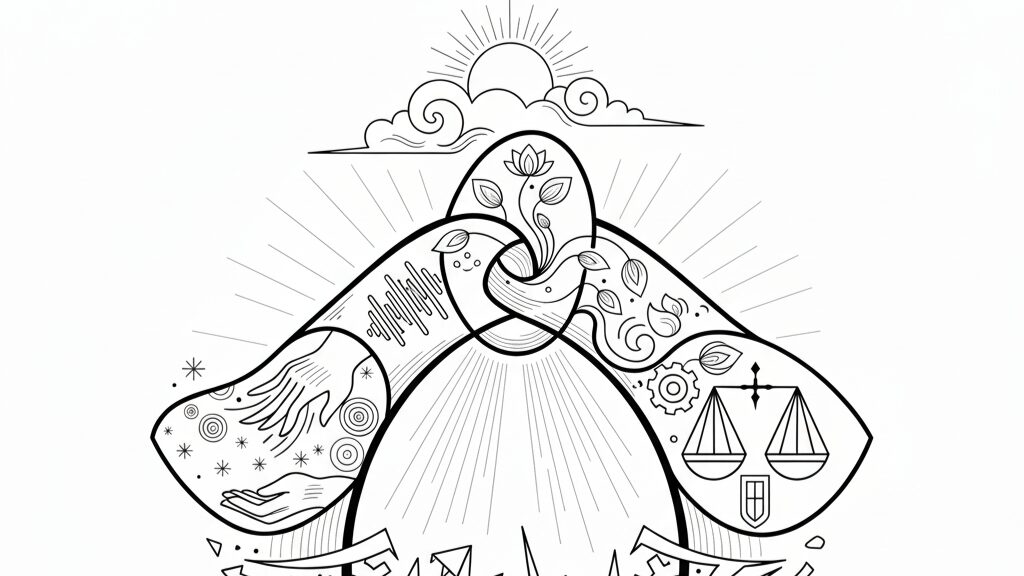
In a world increasingly fragmented by extremism, greed, and a stark lack of mutual respect, many search for anchors – principles that can guide us back to a path of understanding and coexistence. For centuries, the teachings of the Buddha have offered such guidance, and one particular discourse, the Sangaha Sutta from the Aṅguttara Nikāya, shines brightly as a beacon for social harmony.
Hailing from the rich Theravada Buddhist tradition, deeply preserved and practiced in Sri Lanka, the Sangaha Sutta presents us with the Four Bases of Fellowship (Saṅgaha-vatthu). These aren’t just ancient doctrines; they are timeless tools for building bridges in our fractured modern landscape, offering profound insights for individuals, communities, and even nations.
The Buddha teaches that these four qualities are like the linchpin of a cart, holding everything together, ensuring smooth movement and stability. Let’s explore how each one can counteract the divisive forces we face today:
1. Dāna: The Antidote to Greed and Selfishness
Dāna, or Generosity, is more than just giving material possessions. It’s the selfless sharing of our time, knowledge, energy, and compassion. In a world often driven by accumulation and self-interest, practicing dāna actively counters greed. It reminds us that true wealth lies not in what we hoard, but in what we share. When we give freely, we break down the walls of “mine” and “yours,” fostering a sense of shared humanity that erodes the roots of extremism often fueled by resource scarcity and perceived injustice.
2. Piyavācā: Healing Wounds with Kind Speech
How often do we witness heated rhetoric, divisive language, and disrespectful exchanges online and offline? The Buddha’s call for Piyavācā, Kind and Pleasant Speech, is more vital now than ever. This means speaking truthfully, yes, but also gently, considerately, and beneficially. It’s about choosing words that build up, not tear down; that invite dialogue, not escalate conflict. Imagine the transformation if, instead of shouting past each other, we all committed to communicating with respect and warmth. This simple practice can disarm hostility and open pathways to genuine understanding.
3. Atthacariyā: Actions that Unite, Not Divide
Atthacariyā translates to Beneficial Conduct or Doing Good. It’s about taking actions that genuinely contribute to the well-being of others and the community at large. In a world where individualistic pursuits often overshadow collective welfare, atthacariyā calls us to step up. It’s about active compassion – volunteering, supporting ethical causes, standing up against injustice, and working collaboratively for common good. Such actions cut through apathy and cynicism, demonstrating a tangible commitment to a shared, harmonious future.
4. Samānattatā: The Foundation of Equality and Mutual Respect
Perhaps the most challenging, yet profoundly necessary, in our polarized world is Samānattatā, or Impartiality and Consistency. This principle urges us to treat all people fairly and equally, regardless of their background, beliefs, or affiliations. It means recognizing the inherent dignity in every individual and behaving with consistent uprightness. It is the antithesis of prejudice and discrimination. When we practice samānattatā, we actively dismantle the “us vs. them” mentality that fuels so much conflict and disrespect, fostering a deep sense of shared humanity and belonging.
A Path Forward
The Sangaha Sutta tells us that because wise people regard and practice these bonds of fellowship, they achieve greatness and are praised. It warns that without them, even the most fundamental relationships would crumble.
As Theravada Buddhists, we hold these teachings not just as historical relics, but as living guidance. In a world yearning for connection, peace, and mutual respect, the Four Bases of Fellowship offer a clear, actionable path. They remind us that the power to heal divides and build a more harmonious world lies within each of us, through our generosity, our words, our actions, and our unwavering commitment to treating all beings with respect and equality.
Let us embody these ancient truths from the Sangaha Sutta and become the change our world so desperately needs.
Reference: